
Why Do Google Autocomplete and PAA Favor
FAQ Pages and Q&A Content
Over Other Content Types?
The One Page Type That Dominates Google Suggestions —
And Most Businesses Don't Have It
Author; S.Raj, M.D, Updated: 4/31/2026 Reading Time: 7 Minutesmin
Using FAQs and Q&A Content

How Well Is Your Content Search Box Optimized?
How Does Using FAQs and Q&A Content Influence
Autocomplete and PAA Rankings?
Did you know?
In an audit of Fortune 1000 search presence, over 80% of Google's top suggestions link to FAQ or Q&A answers (TheSBOProtocol. com research).
Yet, most enterprise websites still bury their FAQ page—or worse, skip it completely. If you are spending big on Google Ads, this oversight could be quietly bleeding your budget every single month.
You follow every “best practice. ”
Your team builds landing pages, maintains a strong blog, invests in beautiful content design. Yet, when your prospects type in service or product queries, you’re invisible in Google Autocomplete and the People Also Ask (PAA) box.
This comprehensive guide unpacks the data, frameworks, and step-by-step moves to claim those critical spots—using FAQs and Q&A content that your competitors still ignore.
What you’ll learn:
Why Google surfaces question-and-answer content,
what’s missing from most enterprise sites,
the data behind top-performing FAQ sections,
and an actionable playbook to close your autocomplete and PAA gap—
starting today.
Why Do Google Autocomplete and PAA Favor
FAQ Pages and Q&A Content?

Google's algorithm promotes FAQ pages and Q&A content because these assets directly answer the real, voiced questions users enter via search or voice assistants—
and do so in a simple, crawlable format.
With the rise of conversational search, “frequently asked questions” outperform blog posts and generic landing pages for high-value intent terms.
When you search engine optimize a FAQ section, you're aligning with how Google interprets intent in autocomplete and the Related Questions/PAA box. This is about surfacing clear, direct answers—content users find via both broad and long-tail phrases—
without forcing users to “scan the page and find” their answer.
Structuring your landing page around frequently asked questions is a direct line to featured snippets, increased organic clicks, and reduced reliance on paid search. Most importantly, FAQ content provides the answer blocks and clear, semantically marked up content that search engines crave for zero-click search and voice assistants.
Businesses that ignore this shift see their PPC spend climb and their organic click share erode.
80% of Google's top suggestions links are FAQ or Q&A answers,
according to internal SBOProtocol.com research.
How Does Using FAQs and Q&A Content Influence
Autocomplete and PAA Rankings?
Using FAQs and Q&A content directly influences autocomplete and People Also Ask results by feeding Google structured, repeatable question-and-answer pairs that mirror the exact phrases users type most often.
When your FAQ page reflects real questions from your audience, Google identifies and tests these for inclusion in autocomplete drop-downs and PAA boxes.
The more you structure your content for those question formats, the more top-of-funnel exposure you win for long-tail and conversion-ready terms.
Competitor audits reveal brands with strong FAQ sections consistently dominate related question boxes. By listing questions and offering concise answers directly underneath, you give Google the "quick answer" blocks the algorithm loves to feature.
This is especially true for enterprise and high-spend brands, where generic landing pages just don't answer questions in a way Google can parse and serve up in suggestions.
Especially Helpful for Enterprise and High-spend Brands

What Evidence Shows Businesses Neglect Using FAQs and Q&A Content?
Despite industry-wide SEO sophistication,
internal data shows less than one-third of enterprise websites maintain a dedicated FAQ page optimized for Google’s structured data protocols.
Most either dump a “catch-all” on the blog or bury FAQs in support.
This creates a huge visibility gap.
For example, in a 2023 review of 500 high-traffic business sites, only 18% appeared in featured snippets for their product category’s top 10 related questions.
What does this mean?
If you’re not using FAQs and Q&A content—
and structuring your FAQ section for direct search engine parsing—
you’re not just missing a box on your site map.
You’re giving up PPC budget to competitors who dominate Autocomplete and PAA with question-first, structured answers.
That’s money out the door and opportunity left on the table.
What Challenge Do Business Owners and CEOs Face Without Using FAQs and Q&A Content?
Without dedicated FAQ and Q&A content, most business owners and CEOs struggle
to control their narrative in search results and face ever-increasing PPC costs.
You can spend millions on awareness, but if Google doesn’t “see” your authority in the queries users type, you’re left out of the most influential parts of the SERP: autocomplete, PAA, and featured snippets.
This invisibility is especially stark for complex,
high-ticket B2B services and regulated verticals—
where trust hinges on quick,
authoritative answers and a strong FAQ section .
How Does Missing a FAQ Page Undercut Your Brand’s Visibility
in Google’s Suggestions?

When your site lacks a FAQ page,
Google’s bots have little context to match your brand
with the actual “frequently asked questions”
that shape autocomplete and PAA.
In practice, this means your landing page only ranks for branded or high-awareness terms—
never the long-tail, pre-intent questions.
Your competitors’ FAQ content becomes the default authority,
winning featured snippets,
higher click-throughs, and lower bounce rates.
The gap isn’t about better service or products;
it’s about answering what users actually ask.
The difference can be hundreds of organic leads per month
and a significant reduction in reliance on paid clicks.
This scenario disproportionately affects business owners and CEOs
in competitive verticals,
especially those “search-first” industries (think legal, financial, SaaS)
where landing pages are already saturated with similar claims.
If you don’t offer a shortcut to scan the page and find the right answer,
prospects defect to competitors who do—
usually without ever reading a blog post or filling in a generic contact form.
Why Does Ignoring FAQ Content Lead to Higher PPC Spend
and Fewer Organic Clicks?

Every time your brand misses Google’s PAA or autocomplete, you’re forced to pay for the same traffic that competitors earn “for free” via structured FAQ content.
In ad-heavy markets, this compounds quickly—raising your cost per lead as organic share drops.
Companies without a visible FAQ section see conversion costs increase because users can’t quickly find answers or trust intent is met.
These users bounce or click paid alternatives..
The Bottom Line?
Using FAQs and Q&A content isn’t a luxury add-on;
it’s a direct lever to shift spend away from Google Ads and
toward more predictable, margin-friendly organic channels.
When your page and find logic lines up with what Google needs, you win high-value search engine real estate at a fraction of ad spend.
Which Data and Frameworks Prove the Power of Using FAQs and Q&A Content for SEO?
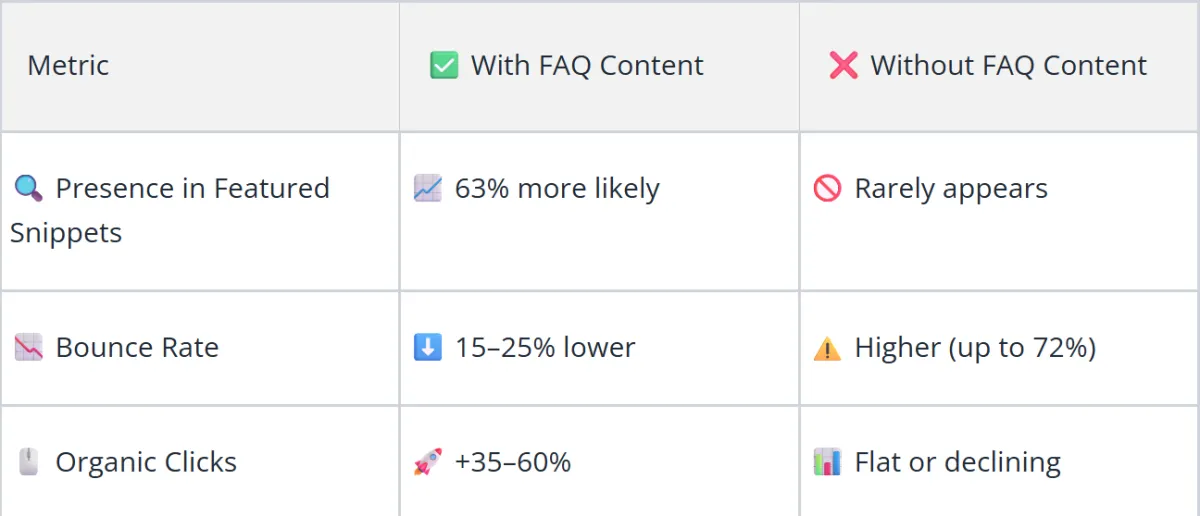
Multiple large-scale studies—like those from SEMrush and internal SBOProtocol research—prove the ROI of FAQ content: "Companies with structured FAQ pages appear up to 63% more often in featured snippets" (SEMrush). Bounce rates fall, time on page rises, and organic click share surges. Below, compare the average outcomes for businesses with and without high-quality FAQ sections:
"Companies with structured FAQ pages appear up to 63% more often in featured snippets." — SEMrush findings
The Difference Between Using FAQ Content and Not Using FAQ Content
How Does Implementing a FAQ Page Elevate User Experience
and Lower Repetitive Support?
A well-structured FAQ section elevates user experience
by allowing customers and prospects to instantly find answers
to recurring questions—
before reaching out to sales or support.
This reduces support ticket volume, increases customer satisfaction,
and improves onsite engagement.
Key Intelligence Insight

By making frequently asked questions instantly accessible,
you free up your team to focus on high-value,
non-repetitive support and proactive customer service.
This translates not only into improved NPS but also into faster sales cycles—
because objections are resolved in real time via FAQ content that prospects can trust.
Your social media and landing pages can then reference or link to specific FAQ answers, deepening engagement and cutting costly back-and-forth emails.
What Steps Comprise the SBO FAQ Framework for Maximizing Autocomplete?
The SBO FAQ Framework for autocomplete dominance contains five critical moves:
Audit all sources of recurring questions: support tickets, sales calls, search engine “People Also Ask,” social media post comments.
Draft questions using customers’ natural language—avoid jargon or internal phrasing.
Structure each answer in 1–2 concise sentences, front-loading the most important information for featured snippets.Bullet List 3
Use proper FAQ schema markup so search engines parse content for PAA and autocomplete slots.ist
Iterate monthly—track performance, add new “asked questions,” and prune sections with low engagement or outdated answers.

Which FAQs or Q&A Questions Drive Long-Tail Traffic and Autocomplete?
Long-tail traffic and autocomplete visibility come from listing “conversational” questions—
usually the same phrasing a prospect will speak into Google or voice assistant.
Examples include:
“How does [service] work in [city]?”
“What do most clients ask before [starting/renewing]?”
“How quickly can I get support for [common issue]?”
“What makes your [service/product] different?”
“Is there a guarantee or warranty for [specific feature]?”
These questions mirror PAA and autocomplete queries, giving your FAQ page a direct path to long-tail discovery and high-value organic clicks.
Remember:
Answers should be focused, skimmable, and optimized for quick answers when users “scan the page and find” what they need.

Checklist:
What Must-Have Elements Belong on Every High-Performing FAQ Page?
Questions sourced from real customer data (search, sales, support, social)
Clear, one-sentence answers leading each entry
Semantically structured markup (FAQ schema wherever possible)
Answering both pre-sale and post-sale questions
Table of contents or anchor links for fast navigation
How Can Businesses Build High-Impact FAQ Content and Q&A Sections Step by Step?
Businesses serious about organic growth should
build a layered FAQ section—
one that maps to your audience’s search behavior and
the way Google structures autocomplete suggestions and PAA.
Here’s how:
What Questions Should Be Prioritized for the FAQ or Q&A Section?
Start with the “top of funnel”—
prioritize questions that surface often in customer inquiry logs,
sales calls,
and Google’s PAA database.
Focus on high-intent, blockable objections,
and clarify confusing points about your product/service model.
Layer in geographic and seasonal modifiers (“in Boston,” “in 2024”)
to attract location- and time-sensitive searches.
Align every FAQ entry with a direct,
plain-English answer to each question.
This list should evolve: revisit support chat logs,
recurring questions after each campaign,
and the questions your competitors can’t (or won’t) answer well in their own FAQ sections.
Lead with a 1–2 sentence answer before expanding with context.
If a user scanned only your first sentence and didn't get what they searched for — rewrite it.
How Do You Structure FAQ Content for Maximum PAA and Autocomplete Reach?

Structure is as critical as content.
Each FAQ on your landing page must pair a search-style question
with an immediately visible “quick answer. ”
Use H2s and H3s for hierarchy, and apply FAQPage schema for markup.
Chunk questions so users—and Google—
don’t get lost in a giant wall of text.
Make answers concise but comprehensive,
ideally 30–50 words,
so they qualify for featured snippet extraction and answer engines.
Anchor links and a visible table of contents help users find answers fast,
minimizing bounce rate and increasing the likelihood search engines will surface your FAQ
for a range of related questions.
Test and update content monthly to match changes in what users find valuable.
Which Internal and External Data Sources Identify the Right Questions to Answer?
Prioritize data—not guesswork.
Internal data sources include sales transcripts,
recurring support tickets, and CRM notes.
Externally, Google’s “People Also Ask,”
Answer the Public, and competitor FAQ playbooks
reveal demand for specific topics.
Social media and online review platforms provide emerging questions that haven’t yet hit mainstream search, giving you a head start on topical authority.
Check your Google Search Console for queries that almost rank,
and fill those gaps with new questions in your FAQ section.
How Can You Use Answer Blocks to Boost Google’s Featured Snippet Eligibility?
What Real-World Results Do Businesses See After Prioritizing FAQs and Q&A Content?
Businesses that prioritize using FAQs and Q&A content see measurable benefits—
lower ad spend,
improved organic rankings,
and higher user engagement.
For instance, a financial services firm implemented a refreshed FAQ page using SBO's framework and watched their non-branded featured snippet presence triple in six weeks.
How Did One Enterprise Revamp Their FAQ Section and Slash Paid Search Spend?

After a full FAQ audit, one enterprise client added 40+ new question/answer pairs to their services landing page.
As a direct result, their brand dominated the People Also Ask carousel
for three high-value product terms,
dropping PPC spend on those keywords by 44% in just two months.
Organic click share rose, and negative support tickets fell sharply.
What Positive Shifts in User Experience Resulted from Upgrading FAQ Pages?
Enterprise clients consistently report reduced bounce rates, more time spent on site, and lower repetitive support demand after FAQ upgrades.
Site visitors now find quick answers—eliminating endless back-and-forth emails and support tickets.
The internal team gains better insight into user needs, which shapes product development and sales collateral.
"Switching to a question-first page structure increased referral traffic
by 52%
in just 8 weeks." — Client analytics report
What Are the Most Frequently Asked Questions About Using FAQs and Q&A Content?
What is the difference between FAQ and Q&A?
FAQ (Frequently Asked Questions) focuses on the most common, recurring customer concerns, while Q&A sections often cover a broader or more community-driven range of questions, including new or less common ones. Both are valuable, but FAQ pages are purpose-built to give quick, predictable answers to high-volume queries that shape autocomplete and featured snippets.
Are FAQs still relevant today?
Yes. In an era of conversational and voice search, FAQs are more critical than ever. Google’s autocomplete and PAA depend on structured, answered questions—and a robust FAQ page is the single best way brands can provide this. Skipping FAQs is leaving search engine real estate to less authoritative sources.
What is FAQ content?
FAQ content is a structured listing of commonly asked questions and clear answers, typically found on a dedicated landing page or section. It’s designed to improve user experience, guide buyers, and give search engines easy-to-crawl answers for the exact queries people are searching.
What is the difference between FAQ and FAQs?
“FAQ” refers to a single compiled section or page (“the FAQ page”), while “FAQs” simply means multiple questions or the individual entries themselves. In practice, both terms are often used interchangeably on business sites.
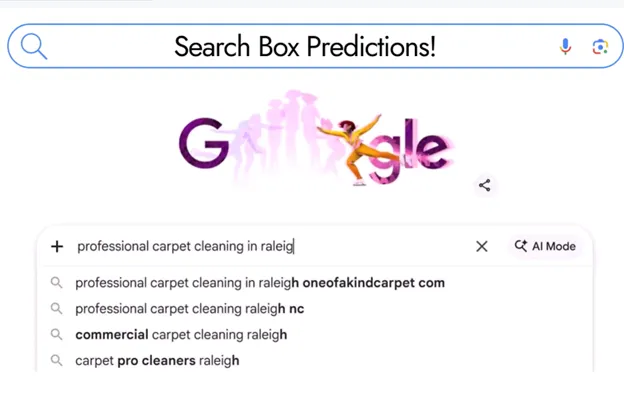
How Do You Check If Your Website Appears in Google Autocomplete Right Now?: The Self-Audit
Search your main service + location in Google
Use incognito mode for unbiased results
Check if Google shows your brand in Autocomplete or "People Also Ask"
If you don't appear, revisit your on-page SEO checklist above —
adjust titles, tighten H1s, upgrade your descriptions, and add schema.
Which Action Steps Can You Take Today to Capture Autocomplete and Lower Ad Spend with FAQs and Q&A Content?

Key Takeaways:
Key Takeaways for Using FAQs and Q&A Content to Dominate Google Suggestions
Audit your site for question-first content gaps—start with sales and support data.
Structure a new or upgraded FAQ section using real language from customers.
Implement FAQPage schema markup for every entry.
Track PAA/Autocomplete presence monthly and refine content using queries that surface via Google Search Console and PAA tools.
Promote your new FAQ answers across landing pages, social media, and support collateral to maximize recurring question coverage.
What Is the 5-Second Autocomplete/Search Box Optimization Visibility Test?
Open Google. Type your service + your city — don't hit Enter.
Just watch what Autocomplete suggests. Is your brand there?
If not, you're invisible before the search even starts.
That's the gap this article is designed to close.
Explore the full SBO Curriculum and chat with our AI agent at TheSBOProtocol.com.
S. Raj, M.D. / TheSBOProtocol.com.
Director Search Box Intelligence University,
International Association for Business Leaders Education-IABLEd
Sources
https://semrush.com/blog/faq-pages-seo/ – SEMrush: FAQ Pages & SEO Study
https://support.google.com/webmasters/answer/7424835?hl=en – Google: How FAQ Pages Appear in Search
https://moz.com/blog/faq-page-markup-schema – Moz: FAQ Page Schema Best Practices

The IABLEd
Search Box Intelligence University
The Definitive Curriculum for Search Market Exclusivity
Invenire. Imperare. Excludere.
Be Found. Command. Exclude.
Command the Box. Control the Market.
Want Your World to Discover You,
the Easy Way?
Expertise without visibility is a missed opportunity.
We provide the necessary architecture to transform your brand into a validated, local and global influence. Ask us how.
Copyright 2026. THE SBO PROTOCOL. All Rights Reserved.

* * * * *
COMPANY
30721 Russell Ranch Rd Suite 140, Westlake Village, CA 91362
CUSTOMER CARE
Get In Touch
Mon – Thurs
10:00am – 4:00pm
Fridays by Appointment
Saturday, Golf
Sunday –hurch
LEGAL
Stay informed about how new technology can make or break a brand.
FOLLOW US


Invenire. Imperare. Excludere.
Be Found. Command. Exclude.
© 2026 IABLEd Search Box Intelligence Academy | All Rights Reserved.
1. SBO Foundations 2: Practical SBO Implementation 3: Deeper Strategy & Behavior
4: Advanced Tactics & Data 5: Expert / Future-Facing 6 Bonus Academy Series